Lolo's morning started out like any other day, searching through warehouses hoping to find a treasure trove of French antiques. He managed to find a few new dealers and drove away with some beautiful pieces.
Louis XV Table with Cabriole Legs Ending in Pied de Biche
Antique French Grandfather Clocks
Hand Carved French Gueridon
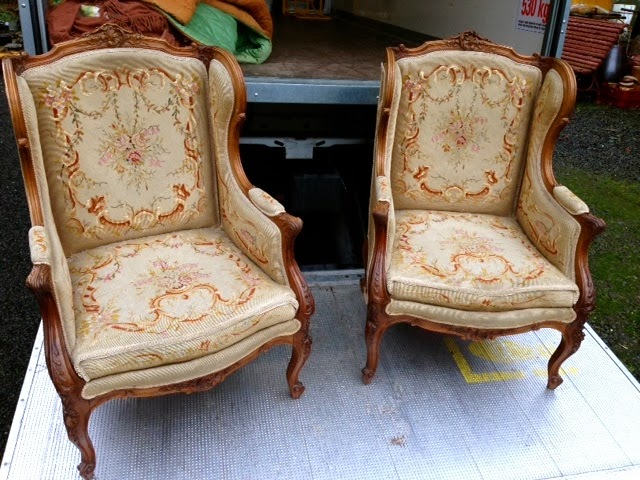
Louis XV Wing Back Bergeres
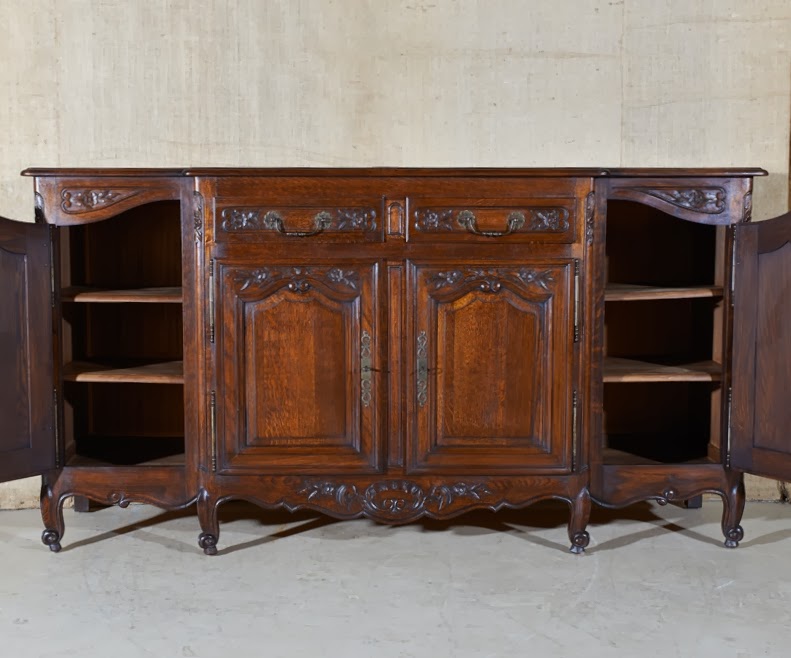
Louis XV Enfilade
Henri II Leather Armchairs
Antique Wooden French Planter
Louis XV Cabinet
Louis XV Chest
As he was off to his final destination, Lolo found himself near Mont Saint-Michel. Known as the Merveille de l’Occident(Wonder of the West), it's one of France's most iconic sights.
Mont Saint-Michel in the distance.
Lolo had always heard of the rocky islet and its tides, but had never been there. He decided to take some time off (something he's learning to do a little more often) and do some sight seeing. And WOW...what a sight to see!
Mont Saint-Michel
Mont Saint-Michel takes you back to the Middle Ages with its amazing architecture set against a backdrop of the area's incredible tides.
Mont Saint-Michel forms a tower in the heart of an immense bay invaded by the highest tides in Europe.
The actual abbey of Mont Saint-Michel is the reason to visit. Surrounded by rock, the abbey provides insight into religious life through 1000 years of architecture. It’s been an important pilgrimage center since 709 A.D.
The Abbey
According to legend, the Archangel Michael told Saint-Aubert, the local Bishop of Avranches, to “build here and build high.” Saint-Aubert built and consecrated a small church on October 16, 709. Archangel Michael reassured the bishop, “If you build it...they will come.” In 966 A.D., a community of Benedictine monks settled on the rock at the request of the Duke of Normandy and the Carolingian church named Chapelle Notre-Dame-sous-Terre (Our Lady underground) was built on the grounds of the oratory erected by Saint-Aubert in the early VIIIth century. Today's abbey is built on the remains of this pre-Romanesque church. Saint-Michel, whose gilded statue decorates the top of the abbey’s spire, was the patron saint of many French kings, making this a favored sight for French royalty through the ages.
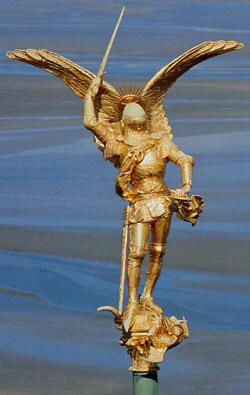
The Archangel Michel by sculptor Emmanuel Frémiet sits atop the neo-gothic spire,
rising over 550 feet above sea level, that was added in 1896.
The abbey was closed in 1791 and used as a prison during the French Revolution. Napoleon finally shut down the prison in 1863 after several influential figures, including Victor Hugo, launched a campaign to restore what was seen as a national architectural treasure. An extensive restoration was required. The abbey was turned over to the Historic Monuments department in 1874 and has been open to the public year round since then. The setting and fine architecture make it one of the major monuments for visitors in France.
Tomorrow, Lolo takes us through a maze of narrow streets leading through areas of shops, restaurants, and hotels. He'll show us the windlass, installed during the use of the site as a prison, which six workers once powered hamster-style to haul two-ton loads of stones and supplies from the landing below. We'll take a look at the beautiful architecture of Mont Saint-Michel and the little village that flourishes on the rock.
Lolo landed safely and hit the pavement...well, French countryside...running! His first stop was a local antique fair where he filled the truck in time to head home to spend some time with his family. Here's a look at a few of the things he stumbled upon.
February 2014 Container
And a look at a few more...
Antique French Laundry Baskets
Louis XIII Bench with Storage
Louis XV Buffet
French Prie-dieu
Remember to "Let Lolo Know" if you see anything you like or have a need for some hard to find piece. He'll search high and low to find that wonderful one-of-a-kind piece you've been wanting!
Tonight, my Valentine (adorable French man with the bluest eyes, most infectious smile and contagious laugh - you know him) and I will be celebrating this most amorous holiday with friends. We've been so busy with shows, trips, holidays and work that we haven't been out on the town in a while. We're having dinner at a tapas restaurant and then we'll dance the night away...Lolo loves to dance!
For those of you looking to enjoy a night in with your Valentine, Lolo and I have several Valentine's Day films we recommend. Valentine’s Day remains a day to celebrate love and love can be found regardless of one’s relationship status as long as you let it. So grab your Valentine or a glass of wine and take a look at some of our favorites.
Some Like It Hot
Synopsis: A 1959 American comedy directed by Billy Wilder with Tony Curtis and Jack Lemmon in drag, hiding out from the mob in an all-girl band after they witnessed the St. Valentine's Day massacre. Marilyn Monroe stars as the dizzy blonde singer who continues to get "the fuzzy end of the lollipop." The screenplay by Wilder and I. A. L. Diamond was based on a 1935 French film, Fanfare d'Amour.
Reasons To Watch: Who doesn't want a Valentine's Day appearance by Marilyn Monroe? This classic screwball comedy was listed as the greatest American comedy film of all time by the American Film Institute in 2000.
The Artist
Synopsis: A clever, joyous film with delightful performances and visual style. The Artist is a heartfelt and entertaining valentine to the early days of cinema. It stars Jean Dujardin as George Valentin, a matinee idol in Hollywood before the dawn of talkies. His marriage is far from perfect, and one day he meets ambitious chorus girl Peppy Miller (Bérénice Bejo) and is smitten. Shortly thereafter, sound comes to movies, and George sinks all his money into one last epic silent film, while Peppy becomes a star in the new era.
Reasons To Watch: Set in 1927 Hollywood during the twilight of its silent era, this exquisite story about love and friendship makes The Artist one of the most original, feel good films of our time. A charming sejour from the day to day grind, it's a tribute to the magic of silent cinema and definitely calls for a warm fire and a glass of your favorite French wine or bubbly.
Amélie (Le Fabuleux Destin d'Amélie Poulain)
Synopsis: 2001 romantic comedy directed by Jean-Pierre Jeunet. This totally charming film stars Audrey Tatou as a shy waitress who spends her time making other people's lives better, while struggling with her own romantic dilemmas. Amélie is a whimsical depiction of contemporary Parisian life, set in Montmartre.
Reasons To Watch: This heart-warming movie will leave you smiling for days because of its originality, romance and joie de vivre.
Love Me If You Dare (Jeux d'enfants)
Synopsis: Part romantic comedy and part black comedy, director Yann Samuell's 2003 feature film starring Marion Cotillard and Guillaume Canet, follows the exploits of two young would-be lovers from childhood as their game of dare becomes more and more reckless and passionate through to adulthood. Julien and Sophie first meet at the age of eight when both are undergoing great trauma: Julien is watching his mother die and Sophie has become the focus of intense hazing at the hands of fellow schoolmates. Always too proud to lose out on the game, the friends keep missing opportunities to be together until a rather surreal but inventive and romantic finale.
Reasons To Watch: This 2003 film features the lead stars at the height of their talent. The song La Vie en Rose permeates the film and dominates much of the soundtrack.
1. Architecture. an interconnected group of rooms arranged usually in a row with each room opening into the next.
2. Military. gunfire directed from a flanking position along the length of an enemy battle line.
verb (used with object), en·fi·lad·ed, en·fi·lad·ing.
1. Military. to attack with an enfilade.
Origin:
1695–1705; < French, from enfiler to thread on a string, pierce from end to end, enfilade, from Old French, to thread, from en- 'in, on' + fil 'thread'.
The French word enfilade in architecture refers to a series of "salons" or rooms, formally aligned with one another, that provide a sweeping view through the entire suite of rooms. The enfilade served to organize space and vision and is a common feature found in many of France's grand palaces from the Baroque period. It is often used in museums and art galleries to help move large numbers of people from one place to another.
An enfilade also refers to a piece of furniture, usually a buffet, in which the cabinet doors reveal connected compartments in a row. It is a long buffet and must have at least three or more cupboard doors. Enfilades add stature to a room with their length and the fact that many are tall.
The French prefer the higher ones to the lower ones and think nothing of serving off one that is over forty inches high. It's all about the look...not ease of use!
In celebration of Valentine's Day, Lolo's decided to share the love. And if there is one thing he loves, it's a crusty French baguette. So...he's giving away an antique French baguette basket.
These baskets, also known as bannetons, were used in boulangeries throughout France by French bakers. The baskets, usually made from willow, provided structure for sourdough breads and wicked moisture from the crust during proofing. Bannetons typically have a linen lining sewn with twine that prevented the dough from sticking to the sides. The cloth was often left unwashed to let the yeast and flour collect, aiding in the proofing process. After the dough had risen, it was removed from the basket to bake and then put back in the basket to cool. Bakers used these baskets until they were literally ready to fall apart, so many of the antique ones have a heavily worn appearance.
This basket will look beautiful displayed in your kitchen...as a centerpiece with dried flowers, fruits or vegetables or use it to hold a row of votives on your table. Line it with an antique French towel and use it to serve a warm baguette. It will be a wonderful French Country accent for your home.
GIVEAWAY RULES
The drawing will be Friday, February 14th, Valentine's Day. To enter the giveaway, you must be a US resident and subscribed as a follower of this blog. Enter to win by following these rules:
3. Scroll to the top of the page and subscribe with your email address to Lolo's French Bloguette in the box that says "Follow by Email."
4. Leave a comment below.
5. For additional entries, share the love! Post the giveaway on your blog, Facebook, Twitter, Pinterest, etc., with a link to our blog and just copy the link into your comment on this post so that we can see it.
I spent most of this past weekend catching up on a whole bunch of blog-reading. I loved Shani Gilchrist's post "Currently I Am..." on her blog, Camille Maurice, and decided that spilling a few beans about what's going on right now with Lolo and me would be a fun thing to do.
Listening...to Edward Sharpe and the Magnetic Zeros. My son and his friends introduced us to this free-spirited band that's a little bit folk, gospel, country and rock'n'roll all-in-one. The infectious melody of their hit song "Home" and a recent rockin' country version of "I Saw Her Standing There," have us hooked on them also. Frontman Alex Ebert recently won a Golden Globe for Best Original Score for his work on Robert Redford's movie "All Is Lost."
My son and his friends with Jade and Alex of Edward Sharpe and the Magnetic Zeros.
Watching...French TV on HULU. Lolo and I love crime dramas. Our two favorite series are set in Paris...imagine that! One is a HULU Original Series called Braquo. It follows a squad of Parisian cops who blur the boundaries of the law. The other, Engrenages, follows the tangled lives of a prosecutor, a police captain, a judge and a lawyer. In the case of learning a foreign language, it seems watching TV is a useful activity. I find I'm actually picking up a few French words chilling on the couch with my honey.
Reading...The Paris Wife. A poignant story of ambition and betrayal, Paula McLain's novel captures the love affair between Ernest Hemingway and his first wife, Hadley Richardson. After they become the golden couple in Jazz Age Paris, their fast-living and free-loving way of life takes its toll on their relationship. I'm the one doing the reading...and asking Lolo a lot of questions about Paris in the 1920's.
Eating...OUT.TOO.MUCH. Especially when Lolo is a trained chef! For those of you that don't know, he went to culinary school in France. And he does all the cooking! But dinner at The Optimist is definitely a treat!
Beignet Style Hushpuppies with Sugar Cane Butter.
Drinking...Hot Tea. SerendipiTea ZZZ. Organic Chamomile and Lavender.
Love this tea!
Wearing...Rosaries and Uggs. I'm wearing antique French rosaries and Lolo is wearing his Ugg slippers. He brings me a really unique rosary back from France each time he goes.
The history of stools in Europe can be traced back to the late 1500's. During the reign of King Louis XIV, when chairs were status symbols and no ordinary person could aspire to own one, a hierarchical seating system featured a fauteuil (an armchair) for the king and queen to sit upon. One did not just take a seat when the King or Queen was present. This was dictated by etiquette.
No one else was
allowed an armchair in their presence, except for another monarch visiting
the French court. He or she would be offered an armchair as
well. A
chair with a back but no arms was considered appropriate for those
closest in rank to the king, such as his brother, sister or children, and a tabouret was provided only for the more privileged ladies of the
court to sit upon in the royal presence. Everyone else was required to stand, no matter their age or
fortune.
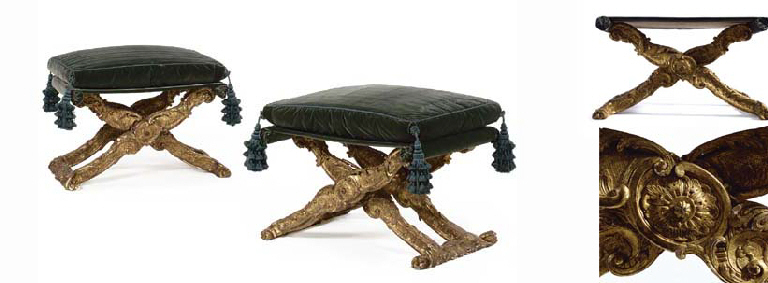
The court tabouret was an elaborate, upholstered stool with curved
wooden legs and tassels, carried by a liveried and wigged servant. It was a much desired honor to sit in the presence of the royal family
and a lady’s rank determined how lavishly her tabouret was decorated. A duchess was automatically granted the
honor of sitting in front of the queen.
This little French stool was such a highly treasured stool and symbol of privilege that when Louis XIV's mother, the Regent Anne of Austria granted the tabouret to two non-duchesses, it caused a disturbance like no other. Such a protest was made that she had to revoke them.
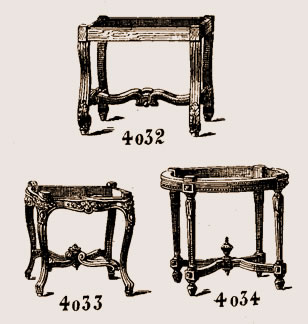
Fig. 4032. Tabouret Loius XIII. Prix, en noyer ciré : 20 francs.
Fig. 4033. Tabouret Louis XIV. Prix, en noyer ciré : 25 francs.
Fig. 4034. Tabouret Louis XVI. Prix, en noyer ciré : 20 francs.
From Le Dictionnaire Pratique de Menuiserie - Ebénisterie - Charpente
By J. Justin Stoeck, 1900
Tabourets
of various designs later became fashionable as household furniture,
particularly in France and England.