
Many consider the marché aux puces (flea markets) in Paris to be a shopper's delight. Where else can you find oddities like taxidermy, fossils and other natural wonders amongst ornaments such as vintage Chanel, art, tattered books and period antique furniture, mirrors and chandeliers? There's only one place...Les Puces de Saint-Ouen.


What began as a shanty town with tin shacks and makeshift stalls of all kinds has become the largest flea market in Paris, and one of the top shopping destinations in the world for dealers, designers and tourists alike. The flea market at Saint-Ouen de Clignancourt, known simply as Les Puces, is actually fifteen submarkets with 2,500 to 3,000 stalls, indoors and outdoors, on and off the beaten path — a labyrinth of narrow winding streets, filled with all kinds of fascinating finds.
The history of the flea markets dates back to the mid-nineteenth century when biffins (rag-and-bone men) and chiffoniers (ragmen) traveled the streets of Paris by moonlight, rummaging through rubbish, in search of desirable objects that had been thrown out with the trash. These scavengers, collectively known as pêcheurs de lune (moonlight fishermen), would then resell their curiosities each day at local markets. The human hair they collected would be used to make wigs. Animal bones would be used for buttons or glue, while animal carcasses would be made into candles. Sardine cans would be used to make cheap tin toys. Rags would be sold to paper producers.
 |
| Menagerie of oddities. Marché aux Puces de Saint-Ouen |
 |
| Les Puces. Photo: ParisSharing on Flickr | License |
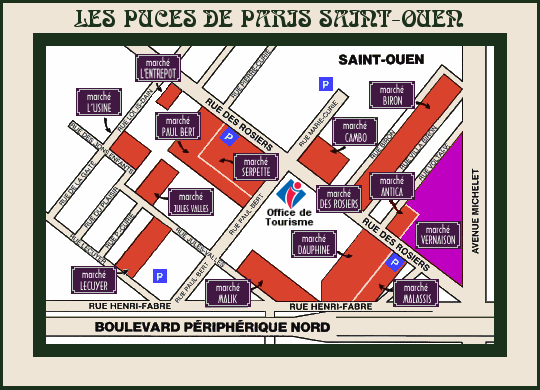 |
| Map of Les Puces de Saint-Ouen |
The history of the flea markets dates back to the mid-nineteenth century when biffins (rag-and-bone men) and chiffoniers (ragmen) traveled the streets of Paris by moonlight, rummaging through rubbish, in search of desirable objects that had been thrown out with the trash. These scavengers, collectively known as pêcheurs de lune (moonlight fishermen), would then resell their curiosities each day at local markets. The human hair they collected would be used to make wigs. Animal bones would be used for buttons or glue, while animal carcasses would be made into candles. Sardine cans would be used to make cheap tin toys. Rags would be sold to paper producers.
 |
| Rag-and-bone man in Paris, 1899. Photo by Eugène Atget. |
In the early 1860's, Baron Haussmann's renovation of Paris, commissioned by Emperor Napoleon III, displaced the street corner markets and the moonlight fishermen were forced to relocate to the outskirts of Paris near the city gates. Ironically, the Baron's attempt to drive the riffraff merchants outside the city only made them more successful. The area beyond the fortifs (fortifications surrounding Paris) was a duty-free zone, exempt from Paris taxes, and proved beneficial to these crafty traders who possessed an eye for style. They continued to troll the streets of Paris on nightly fishing expeditions, returning each morning to their posts at the Porte de Clignancourt, the Porte de Vanves and the Porte de Montreuil, where they set up shop for the day.
The traders quickly realized the benefits of grouping their wares together, and it was not long before curious Parisians, dressed in long gowns and top hats on their Sunday promenades, began to take notice. They gazed in wonder at the bric-à-brac piled on the dirt and stacked alongside the road just beyond Le Périph. As the number of curious onlookers grew, so did the number of traders. Soon, it became fashionable, like a genteel sport, for both affluent Parisian collectors and travelers entering and exiting the city, to come and hunt for bargains amid the miscellaneous objects for sale.

There was one thing the shoppers who frequented the eccentric bazaar every weekend didn't plan on encountering, though....FLEAS! Many of the goods for sale were infested with the dirty little creatures. As a result, Parisians began to refer to an outing to the markets at the edge of town as going to les puces (the fleas). The flea market was born!
Since many of the traders had taken up residence alongside the gypsies in the town of Saint-Ouen, town officials began to take measures to rectify the chaos amidst the shanty town and its motley crew. In 1885, the municipality reorganized the area into several markets along Rue des Rosiers. They provided the bric-à-brac dealers with water and electricity and cleaned up the area to make it safer for both traders and shoppers. Trading became regulated by the municipality. Stallholders were required to pay a fee to set up their stalls, as vendors do today. Roads were paved and walkways were created along the major streets. The appearance improved and rules were established.

 |
| Saint-Ouen postcard |
Les Puces gained official recognition when it was pictured on postcards in the early 1900's and became a highly popular attraction with the opening of the metro station in 1908. Parisians loved the opportunity to find a good deal, and as long as there was a steady flow of shoppers to the flea markets, guinguettes (a type of small bar and restaurant where one could drink cheaply) and other entertainment venues quickly popped up. Music, especially manouche jazz (gypsy jazz), was heard throughout the markets. The rows of colorful stalls that crowded the city gates attracted painters like Renoir and Manet, who frequented the markets in search of used canvases they could scrape and reuse.
Dealers, tired of packing and unpacking their stuff everyday, began selling from enclosed stalls in a covered market where they could lock their wares overnight. The rag-and-bone men and junk dealers were replaced with antique dealers, brocanteurs (second hand furniture dealers) clothing and jewelry dealers. In 1920, Jules Romain Vernaison created the first open air market, Marché Vernaison, within Les Puces and it became an immediate success. Marché Biron, Marché Jules Vallès (the first covered market) and Marché Malik were the next markets to open.
 |
| Paris: Marché Vernaison Antiquitées. Photo by Hellebardius. |
Like all flea markets, prices are negotiable. Admire the merchandise. Be polite. Speak some French, if it's only bonjour or merci. Showing the dealers respect is the best way to get a deal. Though much has changed since 1885, the Paris flea markets are a treasured tradition and being a vendor is a respected profession. If you have just a few days to spend in Paris, with only a day for shopping, the marché aux puces are still a shopper's delight!
À Bientôt!
Lolo & Mimi






#mediaviewer/File:Luigi_Loir_-_Le_march%C3%A9_aux_puces,_Porte_de_Clignancourt.jpg)